What Do PHQ-9, GAD-7, ASRS and PCL-5 Screening Scores Mean?
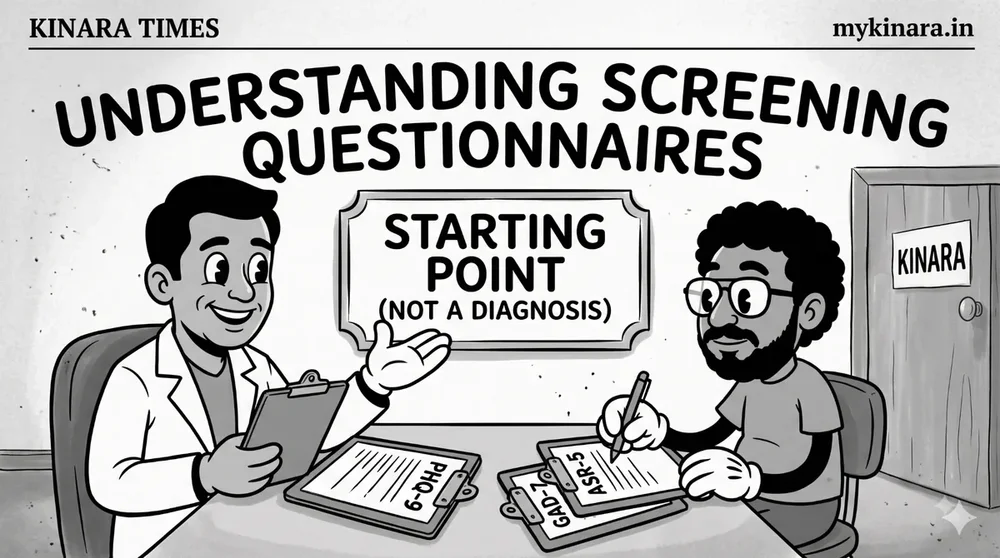
What Is a Mental Health Screening Tool?
You may have seen an online questionnaire asking how often you feel low, worry, lose focus or have upsetting memories. These questionnaires are called screening tools. They help identify symptoms that may need further attention. A screening score is not a diagnosis.
What Do These Four Tools Check?
PHQ-9: Nine questions about symptoms of depression, including mood, interest, sleep and energy (Kroenke et al., 2001).
GAD-7: Seven questions about anxiety-related symptoms, including worry and difficulty relaxing (Spitzer et al., 2006).
ASRS: Questions that can highlight possible attention-deficit/hyperactivity disorder (ADHD) symptoms in adults (Kessler et al., 2005).
PCL-5: Questions about symptoms that may follow a traumatic experience, used when considering post-traumatic stress disorder (PTSD) (Blevins et al., 2015).
What Does a High Score Mean?
A higher score generally signals more symptoms on that particular questionnaire. It does not prove that someone has depression, anxiety, ADHD or PTSD. Stress, sleep problems, another health condition and the situation in which a person answers can affect results. Different tools also use different scoring rules.
What Should You Do With Your Result?
Note your symptoms and how they affect everyday life. A qualified professional can consider your history, context and other possible explanations. If you answer positively to questions about harming yourself, seek prompt support from a qualified professional or urgent service rather than relying on the total score.
Conclusion
Online screening can be a helpful conversation starter. The most useful question is not “What label did I score?” but “What support, if any, do I need?”
References
Blevins, C. A., Weathers, F. W., Davis, M. T., Witte, T. K., & Domino, J. L. (2015). The Posttraumatic Stress Disorder Checklist for DSM-5 (PCL-5): Development and initial psychometric evaluation. Journal of Traumatic Stress, 28(6), 489–498.
Kessler, R. C., Adler, L., Ames, M., et al. (2005). The World Health Organization Adult ADHD Self-Report Scale (ASRS): A short screening scale for use in the general population. Psychological Medicine, 35(2), 245–256.
Kroenke, K., Spitzer, R. L., & Williams, J. B. W. (2001). The PHQ-9: Validity of a brief depression severity measure. Journal of General Internal Medicine, 16(9), 606–613.
Spitzer, R. L., Kroenke, K., Williams, J. B. W., & Löwe, B. (2006). A brief measure for assessing generalized anxiety disorder: The GAD-7. Archives of Internal Medicine, 166(10), 1092–1097.