Sensory Overload, Insomnia and Delayed Sleep Explained
What Is Sensory Overload?
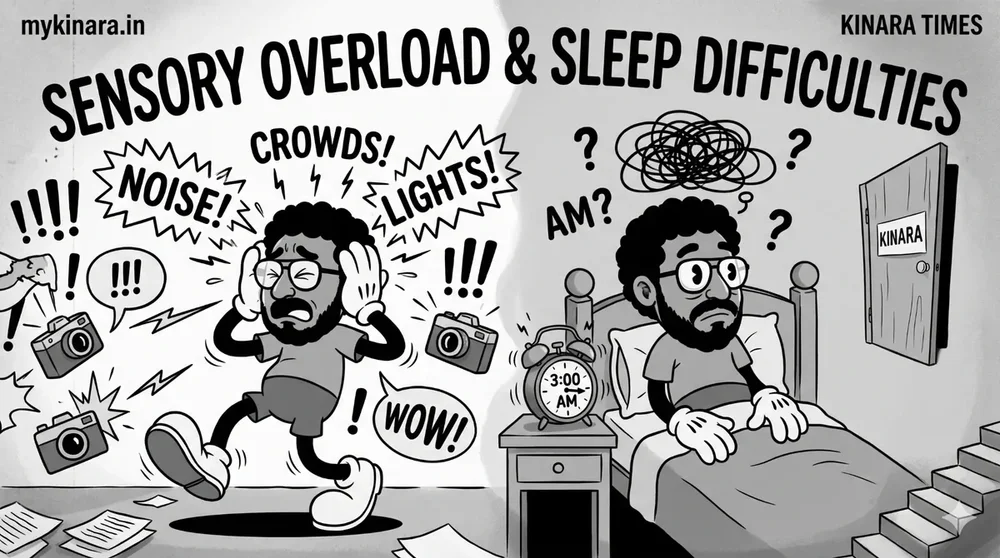
Think of being in a crowded room with bright lights, music and several people talking at once. For some people, the amount of sound, light or activity can feel overwhelming. They may want to leave, cover their ears or sit somewhere quiet.
People experience sensory input differently. Research has explored links between sensory differences and emotional difficulties in autistic people, but feeling overwhelmed by noise does not mean someone is autistic (Chen et al., 2024).
Insomnia or a Delayed Body Clock?
Two sleep problems can look similar but have different patterns.
Insomnia: You have a suitable chance to sleep but struggle to fall asleep, stay asleep or wake too early.
Delayed sleep-wake phase: Your usual sleep time is much later than you want it to be. You may sleep reasonably well on your preferred late schedule but struggle with early classes or work (Micic et al., 2026).
Why Does the Difference Matter?
Trying to force an early bedtime may not solve a body-clock problem. Similarly, people with insomnia may need help with habits and thoughts that keep sleep difficulties going. A clinician can consider sleep timing, routine, health and medication before suggesting care.
What Can Help?
For sensory overload, notice your triggers and try changes such as a quieter space or a short break. For persistent insomnia, a structured talking treatment called CBT for insomnia has good evidence (Trauer et al., 2015). A delayed body clock may need a different, carefully timed plan; do not start sleep medicines or light-based treatment without appropriate advice.
Conclusion
Sensory overload and sleep difficulties are different experiences. Understanding the pattern is a useful first step towards practical support.
References
Chen, Y., Xi, Z., Saunders, R., et al. (2024). A systematic review and meta-analysis of the relationship between sensory processing differences and internalising/externalising problems in autism. Clinical Psychology Review, 114, 102516.
Micic, G., Reynolds, A. C., Phillips, A. J. K., et al. (2026). Understanding delayed sleep-wake phase disorder (DSWPD): Mechanisms, comorbidities, and evolving approaches to diagnosis and treatment. Sleep Medicine Reviews, 86, 102240.
Trauer, J. M., Qian, M. Y., Doyle, J. S., Rajaratnam, S. M. W., & Cunnington, D. (2015). Cognitive behavioral therapy for chronic insomnia: A systematic review and meta-analysis. Annals of Internal Medicine, 163(3), 191–204.